



1. Cave de l’hôtel de ville – The time-travelling wheel
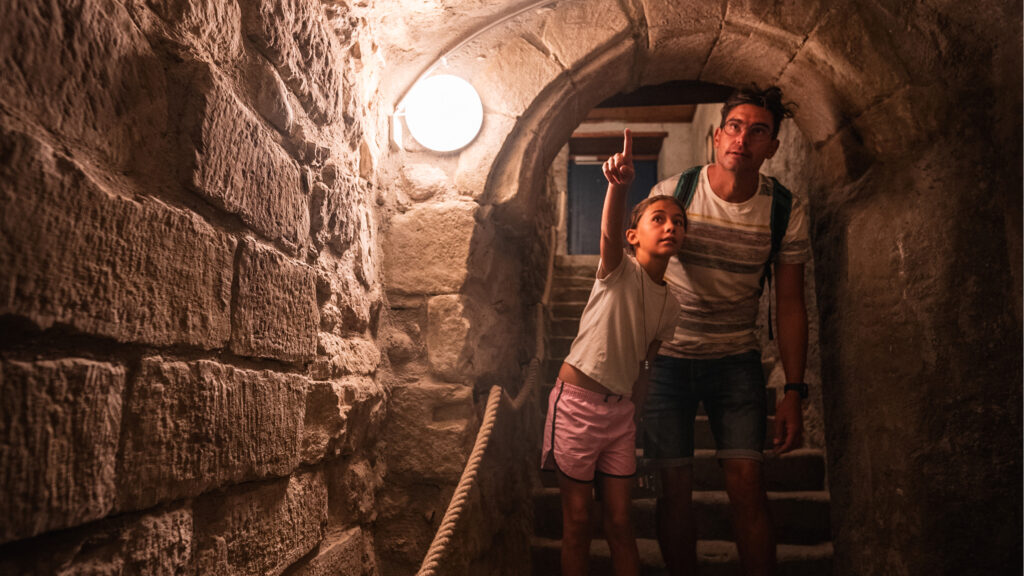
Follow the wheel of Rue through history, from Roman times to the Napoleonic wars.
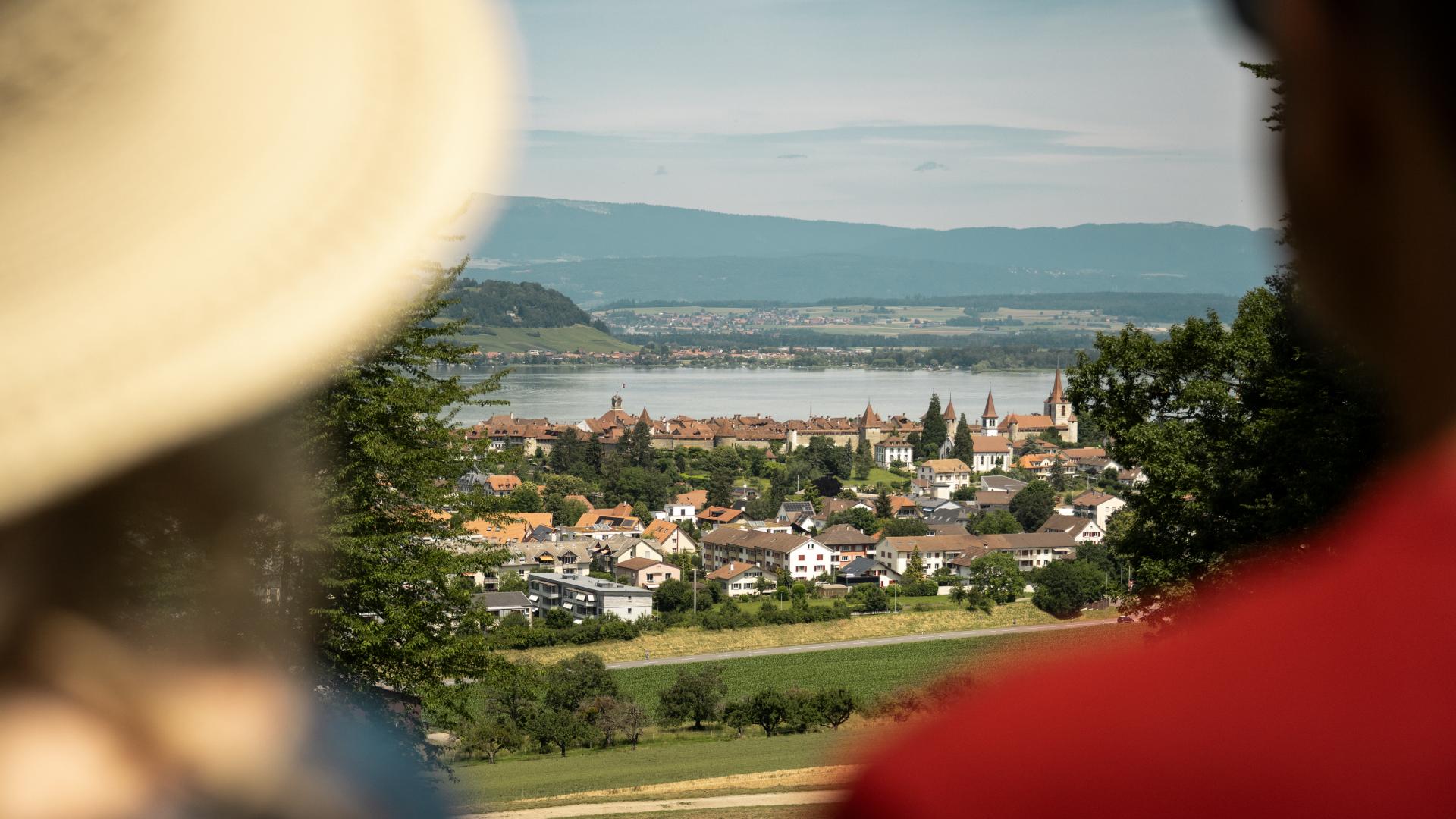
Rue, the smallest town in Europe, owes its status to recognition in 1260 by Peter II, Count of Savoy, who granted it exemptions from customs duties and the right to raise duties and taxes. A lord (known as the ‘Seigneur’) lived in its castle, its bustling streets were full of taverns and shops, and a monthly fair was held there. This small walled town had previously been the district capital of the district of Rue, with the prefecture in the castle. By the year 1000, the wheel (‘la roue’ in French) was already the coat of arms of the lords of Rue. This symbol will guide you throughout the Circuit secret.® Find the wheel in this room and it will enable you to activate your time machine. Bon voyage!
TELL ME ABOUT RUE’S HISTORY…
Switzerland was first occupied by the Romans between the first century BC and the first century AD. At that time, it was divided into five Roman provinces, crossed by major roads. The name Rue is derived from the Latin words “ruga”, which means “street” or “road”, and “rota” which means “wheel”.
One of the largest towns was Aventicum (Avenches). Traces of the Roman era remain there, the amphitheatre in particular.
Around 223 AD, the Romans built the first stone building in Rue, a fortified tower.
On 2 March 1797, the troops of the Emperor Napoleon Bonaparte passed through the town of Rue with around 6,000 men and 16 canons to take Fribourg.
At the beginning of the 20th century, Rue had around 500 inhabitants. Ferdinand Ferber, the son of the castle’s owner, made the first aircraft flight in Europe, flying over the town where he had carried out his first tests of flying machines a few years earlier.
Today,the town has over 1,500 residents. The municipality now also includes the villages of Blessens, Gillarens and Promasens.
In 2025, the municipalities of Auboranges, Chapelle, Ecublens and Rue will merge under the name Rue. The municipality of Rue will then become the third largest in the district of Glâne.
2. Cave du château – Human warmth
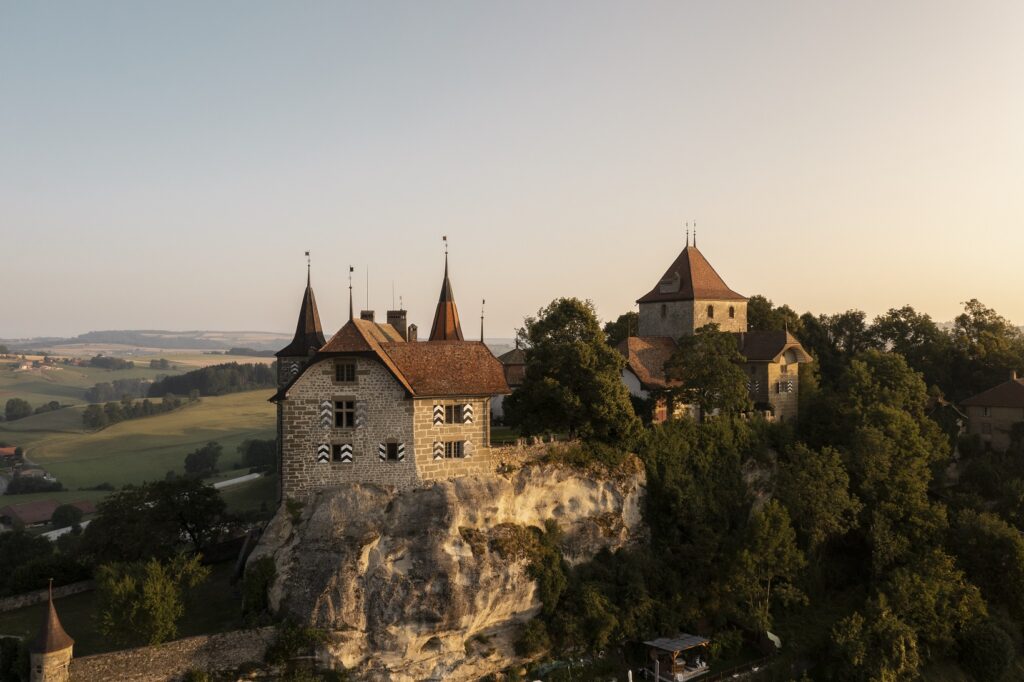
The town is under attack! Take refuge in the castle cellars, where the inhabitants of the medieval town have gathered.
We are in the Middle Ages and wars have long ravaged the region. Bandits are hiding in our forests; petty warlords want our lands and marauders are greedy for our property.
The castle was taken and destroyed in the past, but we have rebuilt it and it is stronger than ever.
Our scouts have reported that Count Pierre IV de Gruyères is marching toward Rue with 150 men. It’s possible that they will try to take the castle. Let them come! We are ready for them, with crossbows loaded and swords in our hands…
The former cellars (where you now are) will provide a refuge for the town’s inhabitants and their cattle in the event of an attack. They get into the cellars, which are dug from the rock, by the external staircase.
The cellars have a huge fireplace, two bread ovens, and provision for people to wash themselves and do laundry in order to survive.
TELL ME ABOUT RUE’S CASTLE…
The first reference to a castle in Rue, and of the lord Rodolphe de Rue, vassal of the counts of Geneva, dates from 1152. Inside these fortified walls were three dwellings. The square keep appears to Date from this period.
Between 1235 and 1237, the fortifications were destroyed and it was forbidden to rebuild them for 15 years. Peter II, Count of Savoy, who now dominated the canton of Vaud, rebuilt the castle from 1260 to 1268 and installed a chatelain as a vassal of Savoy. The buildings were largely destroyed during the Burgundian Wars in 1476. From 1619 to 1673 the castle, which was probably very run down,
was rebuilt and a prison installed there. Fribourg installed first its bailiffs, then its prefects there until 1848.
On 25 February 1856, the State sold the castle at auction. There was a succession of owners. The castle is currently privately owned.
In the courtyard there is a small building that houses the well. The current stone bridge replaced the medieval drawbridge, and the pool was created by the last prefect of Rue before 1848.
3. Donjon – The witch’s lair
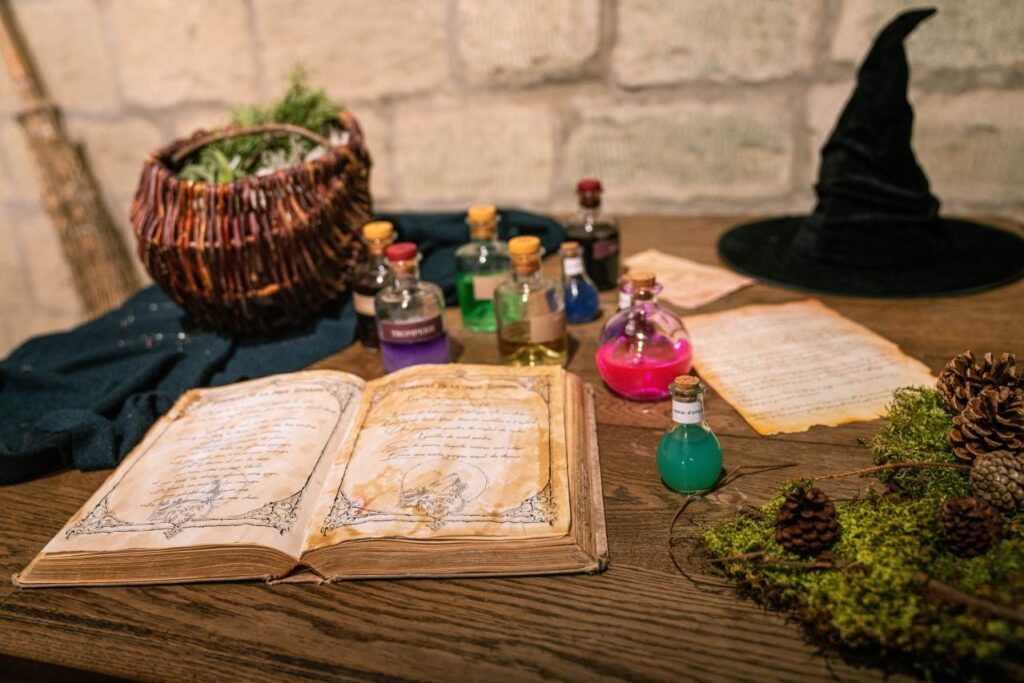
Foolhardy people! There is still time for you to retrace your steps. A scary witch called Mia Varmy is hiding in the keep. It seems that she made a pact with the devil near the grotto in Rue. Her book of magic contains spells to kill cattle and make people ill.
Don’t you believe me? But I swear that it’s true! Everyone in town says so……
TELL ME ABOUT MIA VARMY…
Mia Varmy’s trial for witchcraft began on 1 March 1634. It went on for several days. It was the respectable, wise and prudent Seigneur Jost Ammann, a wealthy citizen of Fribourg and bailiff of Rue, who was responsible for the trial. When tortured, Mia Varmy confessed to meeting a devil named Gabriel and making a pact with him. She said she had taken part in dancing around a fire, near the Pont de la Broye, in the direction of Montet, and had eaten animals and drunk cider and spirits, also known as eau-de-vie.
When tortured for the third time, by hanging with a 100-pound weight, she confessed to killing cows, calves and goats. She said that she had transformed herself into a wolf, on the orders of the devil, to kill the livestock.
On 15 March she was condemned to be burnt at the stake. She was tortured again, by pincers applied to two sensitive parts of her body, to obtain her final confessions and the names of her accomplices. She was executed on 20 March 1634 on the burial mound at La Fin des Fourches. A chestnut tree was planted there but did not thrive.
Legend has it that, even today, there are two caves hidden in the forest, hollowed out long ago by a stream passing by. They are known as ‘the witch’s grotto’ and ‘the devil’s hole’. Watch out, children, if you are exploring there!
TELL ME ABOUT THE WITCH HUNTS
Switzerland was one of the most violent centers of witch hunts in Europe between the 15th and 18th centuries. Women were the most affected. They were mostly widows, elderly, single, or socially isolated. Those in caring roles, such as midwives, healers, or herbalists, were particularly vulnerable to accusations, especially in cases of medical failure or during times of crisis such as epidemics or poor harvests.
Witchcraft mainly served as a tool of social and gender control in a society dominated by fear, religion, and patriarchy. In Switzerland, particularly in the canton of Fribourg, accusations were based on everyday practices that were reinterpreted as diabolical.
Torture was systematically used to extract confessions of impossible acts (night flight, participation in sabbaths, transformation into animals). In the face of such extreme violence, it was nearly impossible to defend oneself; once accused, conviction was almost certain. The death penalty, usually execution by burning at the stake, served both a punitive and deterrent function, turning these executions into public shows meant to maintain social order.
- It is estimated that between the 15th and 18th centuries, there were approximately 10,000 witchcraft trials in Switzerland.
- The first major trials appeared in the cantons of Valais, Fribourg, and Vaud.
- Among these trials, around 6,000 executions are believed to have taken place.
- 70–80% of the accused were women; 20–30% were men and children.
- The last witch in Europe was executed in Glarus in 1782.
- The trials begin and end in Switzerland.
4. Sommet du donjon – This magnificent man in this flying machine
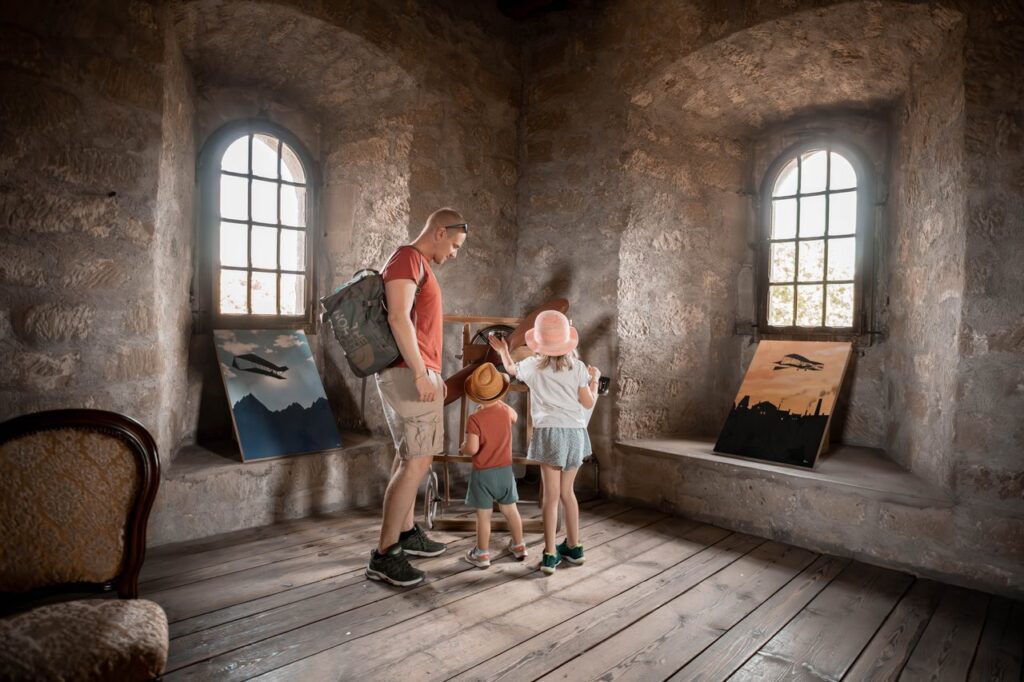
Humans have always dreamed of flying like birds. In 1900, the dream is close to realisation, and there is a race between aviation pioneers. Who will be the first to make a flying machine?
Ferdinand Ferber is the son of the owner of the castle of Rue. A captain in the French army, he has always had his eyes turned towards the sky, dreaming of making his own flying machine. When staying in the area, he has carried out numerous test flights from the castle with gliders.
Today, he’s getting ready to test his first powered aircraft. The flying machine is ready to take off. Help Ferdinand to get it started!
TELL ME ABOUT THE FIRST FLIGHT IN EUROPE…
Ferdinand Ferber, born in France in 1862, was a pioneer of French aviation: an observer, experimenter and author of publications about the early history of aviation. During a visit to his father, Ernest Ferber, at that time the owner of the castle, he tried to fly a parachute (a hang-glider) from the castle’s highest window in the afternoon of Sunday 24 October 1898. The parachute weighed 30kg with a span of 8m and load-bearing surface area of 25m2.
On 30 September 1899, convinced that flight was possible, he tried to fly another aircraft (a glider) pulled by a galloping horse on the Prés-du-Château in a place known as Cheneveirettaz.
In 1906, he achieved the first powered flight in Europe, flying over the town of Rue.
This “Faucheur de Marguerites” (meaning ‘mower of daisies’- a French nickname for aviation pioneers) used the pseudonym Ferdinand “de Rue” at meetings abroad. He died on 22 September 1909 in Boulogne-sur-Mer, crushed by the engine of his aircraft after touching down at a meeting.
5. Cave des chevaliers – The duel
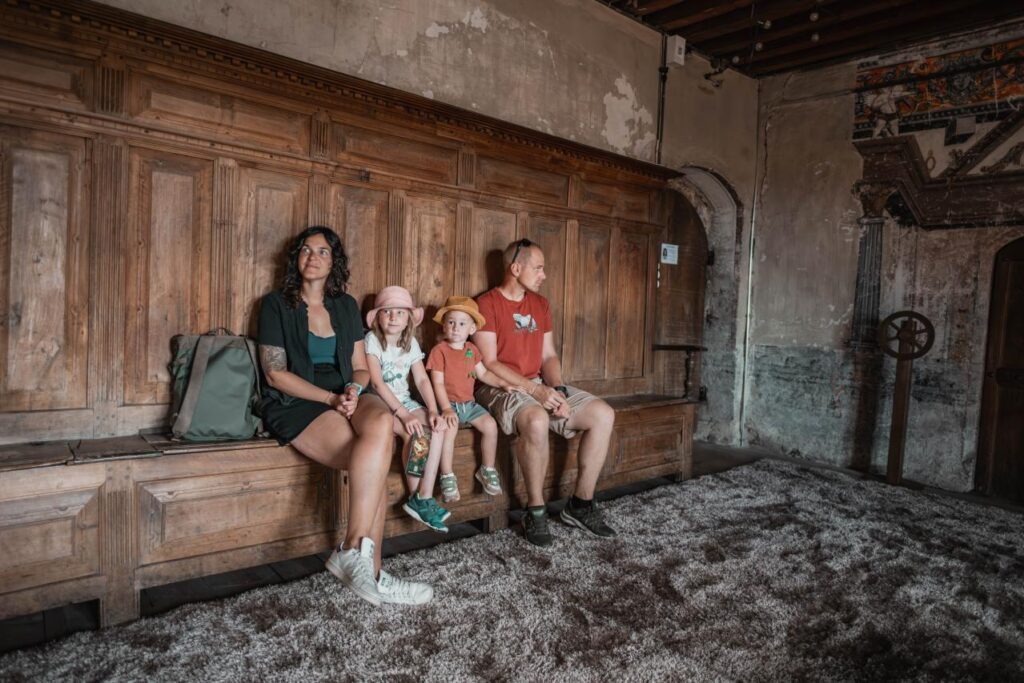
The Maison de Prez (de Prez House), built on the foundations of an even older house, has stood in the middle of the village since the 14th century.
We are now in the room of the Chevaliers, at the start of the 18th century. The house has belonged to the Maillardoz family for several generations, and they have invited two local gentlemen to come here to settle a dispute. Silence! You are going to see an affair of honour!
TELL ME ABOUT THE MAISON DE PREZ…
The complex is composed of a large house to the south and a barn-stable opposite it, one of the few buildings in Rue never to have been modified since the 18th century. The Maison de Prez is the largest great house in the canton of Fribourg. It was the residence of the de Prez family and then of the Maillardoz. The coats of arms of both families are displayed on its main façade:
- The de Prez coat of arms, with a demi-lion rampant, on a sculpted molasse plaque.
- The Maillardoz coat of arms, which has crumbled, between the windows on the first and second floors.
Richard de Prez founded Rue’s chapel of St-Nicolas, which became the parish church in 1622, with the approval of the Bishop of Lausanne
The Maison de Prez now belongs to the Crausaz family, who have owned it for many years.