

The English garden on Gruyères Street
The English gardens emerged in the 18th century as a break from the strictness of the "French" gardens, showcasing a new sensitivity towards nature. Rather than taming it, the aim was to idealise it in order to create living tableaux inspired by landscape painting. Under the influence of Romanticism, the garden becomes a refuge conducive to daydreaming. Popularised by landscapers like Capability Brown, this model favours curved lines, winding paths, and the use of "follies" (small ornamental constructions). Water loses its verticality; ponds with irregular banks integrate into a discreet harmony with the surrounding vegetation.
In the 19th century, this aesthetic adapts to the development of cities. The English garden becomes a public park open to all, providing a green lung against industrial urbanisation. In Bulle, this influence is first manifested at the end of the 19th century in the private park of the Hôtel des Alpes, where concerts and balls attract clientele and locals alike.
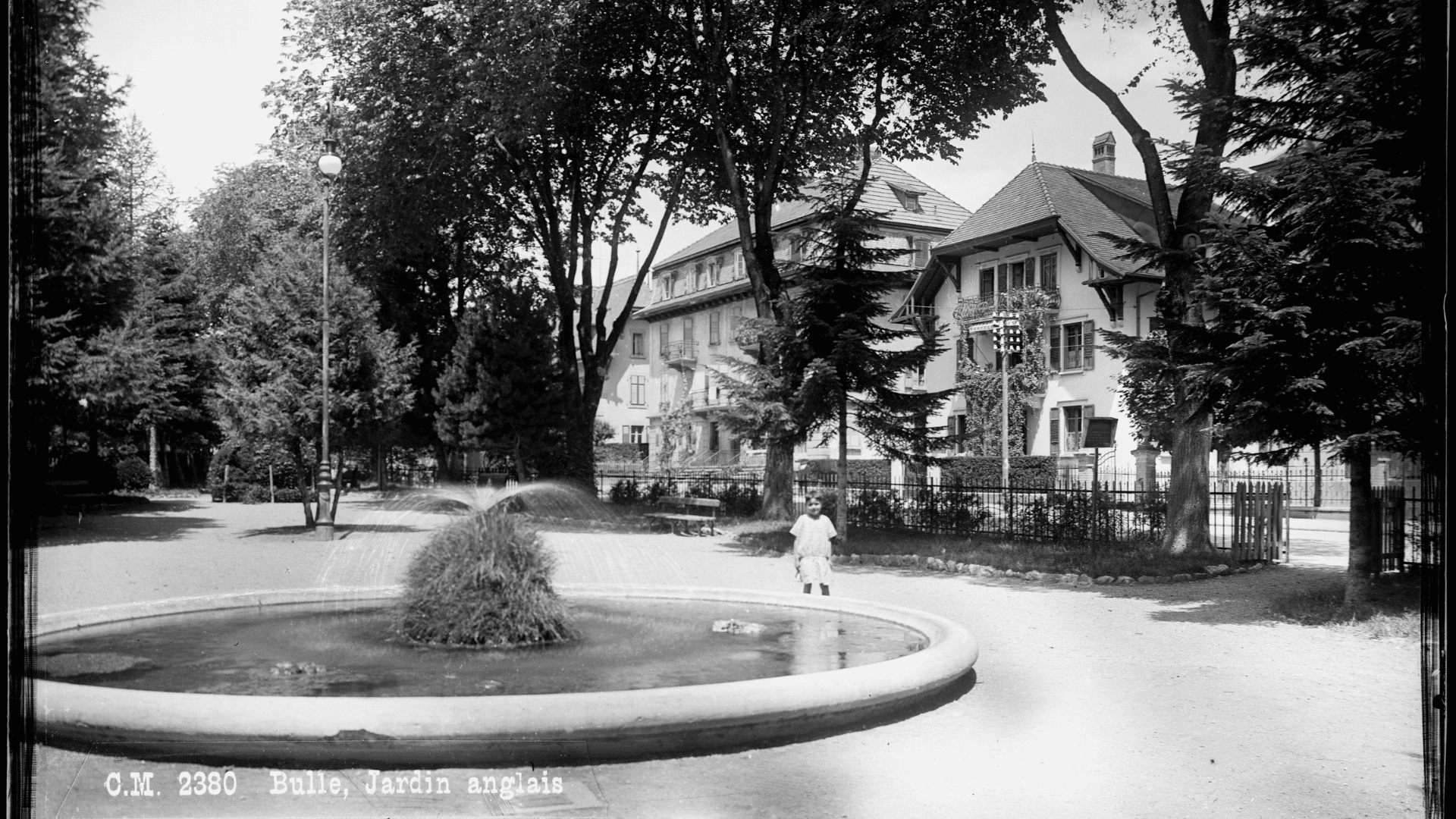
It is in the early 1900s that a true public English garden is established on Rue de Gruyères. This project is part of a modernisation of the neighbourhood, notably marked by the inauguration in 1906 of Brasserie La Viennoise. With its Art Nouveau decor and refined stained glass windows, the establishment becomes the social extension of the garden, a meeting place for strollers. That same year, a basin is installed at the heart of the park, enhancing this atmosphere of relaxation. In 1929, the garden acquires a memorial dimension with the inauguration of a monument in honour of Léon Progin, an aviator from Vaulruz who disappeared in 1920, near the Russalet farm, occupied by the aviator's adoptive father, Jean Guillet (1867-1930), and his mother, Marie, née Progin (1866-1926).
Old photographs show a space much larger than today. The size of the garden has been reduced over the course of the 20th century to meet the needs of modernising the road network. A major turning point occurred in the 1960s with the construction of a new main bridge over the Trême, which once again altered the original layout of the park. The successive widening of the road ultimately restricted it to its current triangular shape.
Despite these transformations, the garden today retains its soul thanks to its remarkable trees. The Giant Sequoia and the Lawson Cypress provide dramatic verticality to the place, while the Silver Maple and the Lindens continue to offer the shade and serenity characteristic of the romantic ideal.
Information
Musée gruérien
Rue de la Condémine 25
1630 Bulle
La Gruyère Tourisme
Centre commercial Velâdzo (rez inférieur)
Place de la Gare 3
1630 Bulle