

The lime tree of General Pau
Located at the back of Saint-Denis Square, where the sale of cattle once took place, the lime tree of General Paul Pau (1848-1932) stands as a memorial, echoing the monument to Abbé Bovet that it accompanies. This tree serves as a reminder of the significant commitment of the Gruériennes and Gruériens in welcoming wounded French and Belgian prisoners of war during the First World War (1914-1918).
As early as 1916, neutral Switzerland agreed to accept sick or wounded prisoners of war to relieve detention camps. Germans and Austrians were mainly stationed in the cantons of Bern and Graubünden. In total, over 67,000 people found asylum and protection in Switzerland. Gruyère also became a preferred temporary refuge, particularly for Belgians and French. These men transitioned from the hell of the trenches and combat zones to what many described as a “golden prison.” In Bulle, they were mainly housed at the Hôtel des Alpes and the Hôtel de Ville. They rediscovered a forgotten comfort and a monitored freedom that allowed them to integrate into local life.
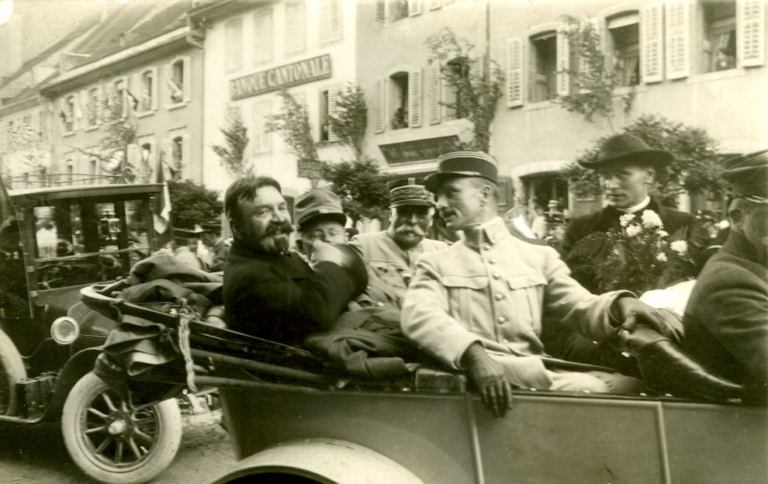
On 12 June 1917, the city of Bulle was marked by an event of major symbolic significance: the visit of French General Paul Pau. A veteran of the 1870 war, who had lost an arm, the general undertook a tour of Swiss sites welcoming his compatriots. This visit left a lasting imprint, engraved on the lime tree in the square: “Tree of General Pau, 12 June 1917.”
Upon his arrival, the general was greeted by an enthusiastic crowd. An official banquet was organised, bringing together the notable figures of the region. Among them, Alexandre Cailler, a national councillor and director of the Broc chocolate factory, played a key role. His presence symbolised the union between federal Bern and economic Gruyère, which had largely contributed to the humanitarian effort. Next to him were Prefect Pierre Gaudard (1870-1934), Syndic Lucien Despond (1869-1951), the president of the Société française de Bulle, Ferdinand Truffat (1866-1939), as well as Professors Garriel and Girardin from the University of Fribourg.
The emotion of this day is particularly palpable in the writings of Rodolphe Bochud, the priest of Neirivue. In his diary, he immortalises the moment when military solemnity gives way to sympathetic attentions:
“The general walked towards the internees, passing in front of a group of children dressed as armaillis who presented him with two bouquets, exclaiming: 'To the brave defender of France, the little armaillis of Neirivue wish a warm welcome. Long live France!' The general touched the forehead of each child and placed a kiss on the heads of the bouquet bearers, then, passing in front of each internee, he addressed a few words to them while shaking their hands.”
Before departing, the general left an indelible impression behind, and Father Bochud noted that he had captured two snapshots of this scene, precious visual testimonials of a shared fervour. Such popular enthusiasm for General Pau's visit can also be explained by the polarisation of Swiss opinion during the First World War. This is what historians call “the moral divide,” a profound divide of opinion between German-speaking Swiss, who were mostly in favour of the Central Powers (Germany and Austria-Hungary), and French-speaking Swiss, who were mostly in favour of the Allies (France, England, and Russia).
General Pau took advantage of his visit to Bulle to personally express his gratitude to Cécile Despond (1869-1936), the syndic's wife. He acknowledged the “motherly” attention she showed
to the internees, a dedication that would lead, two years later, in 1919, to the founding of the Gruyère section of the Red Cross.
Information
Musée gruérien
Rue de la Condémine 25
1630 Bulle
La Gruyère Tourisme
Centre commercial Velâdzo (rez inférieur)
Place de la Gare 3
1630 Bulle