

The lime tree, witness of history(s)
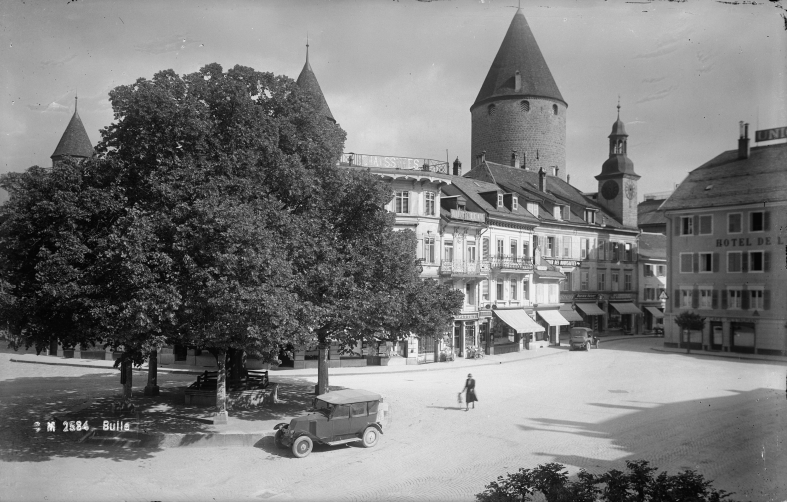
For nearly three hundred years, the historic lime tree of Bulle – most likely a Tilia platyphyllos (large-leaved lime) – has been a marker of urban architecture. Far more than a mere ornament in the city centre, the lime possesses a wide crown whose shade acts as a natural thermal regulator, fostering, in a way, a "living forum" and transforming the public square into a haven of coolness from the mid-18th century onward.
Beyond its biological function, the tree has been a privileged witness to the political upheavals of the region. In May 1781, it became the nerve centre of the uprising led by Pierre-Nicolas Chenaux. It was on its bark that the wanted notice against Chenaux was posted by the Fribourg authorities. Like today’s social media, the lime served as a platform for the insurgents. In 1798, at the time of the French invasion, it was declared the "Tree of Freedom".
The tree's resilience in the face of urban tragedies was remarkable. It notably survived the devastating fire that ravaged Bulle in 1805. Around 1850, a stone structure (tanzlinde) was added to support its branches, and an official measure (half ell, approximately 60 cm) was implemented, reinforcing the tree’s heritage value. This measure was then essential for the economy of braided straw: it allowed for the verification of the length of braids sold on the market, thus ensuring fair trade. By taking on this function, the lime became the guardian of commercial integrity.
However, the weight of centuries and soil compaction due to urbanisation eventually weakened this colossus. By the early 21st century, the diagnosis was unequivocal: the tree was dying. A dendrochronological analysis confirmed its respectable age of 273 years, shortly before its felling for safety reasons in 2003. This moment of rupture was experienced as a collective mourning, compensated by the planting of a successor the following year, in 2004.
Today, the memory of the old lime is preserved at the Musée gruérien in Bulle. The original half ell, a testament to the economic importance of the tree for the city, is carefully kept there.
In order that the remains of the colossus do not end up entirely at the sawmill, an initiative for "secular relics" also accompanied its end. The wood of the giant, prized for its softness and the fineness of its grain, was entrusted to local artisans, who created souvenir objects allowing the residents of Bulle to take home a physical fragment of their heritage.
It should be noted that the lime is the royal essence of cooperage (wood carving): lime wood, white and homogeneous, is the ideal material for making the famous cream spoons.
Beside the political lime and the lime of marriages, the town of Bulle also has a trading lime, located at Rue de la Sionge, whose trunk served as a notice board for livestock sales.
These three historical limes mark the urban space of the town of Bulle. They illustrate the symbiosis between local flora, religious beliefs, democratic aspirations, and the commercial dynamism of the Gruyère. Always present, they link the past and the present.
This connection between commerce, politics, and democracy can be found in the poem
Stanzas to the lime of Bulle, written by the poet, postal clerk, lawyer, attorney general, national councillor, federal judge, Nicolas Glasson, around 1850:
Old witness of the virtues and customs of our fathers, Greetings! from your foliage to the hospitable dome, You cover with your shadow both our games and our fairs, And from the old times, you remain the heir for us.
When iron and fire devoured the city, When the paternal roof collapsed upon the stones, You alone rose with your majesty, spared by fate amidst the total ruin.
You saw kings and times and fashions pass by, You saw conquerors, you saw the oppressed; You saw our convenient freedoms blossom, And through our old ancestors, your branches were loved.
Under your shadow often, in the evening, when night closes, The old man comes to sit down and dreams of days gone by; He thinks of the days of hope, of the future, of the rose, Of the happiness that flees, of the pleasure that fades.
And the young beauty, modest and blushing, Also comes, under your dome, to listen to the sweet confession, And her heart beats with love, and her trembling hand Joins the other hand in a jealous transport.
You were the sacred tree, the tree of the homeland, The centre of gatherings, the forum of cities; And if ever the withered freedom were to darken upon us, you would restore it to us!
For you speak to us of them, of those men of iron, Who broke the shackles of tyranny; You tell us that their blood flowed for the ether, And that the sons of Switzerland are not slaves.
Oh! stay long alone, in the middle of the square, With your strong arms embracing the horizon; That the child of the city, passing by, greets you, And respects, in your trunk, a holy prison.
A prison of memories, of glory and hope, Where the names of those who are no more are hidden; Where one believes to see wandering, in their noble assurance, The shades of our valiant ones, of our vanished leaders.
And when winter comes, stripping your finery, When the snow covers your intertwined branches, You will still tell us, despite the cold, That generous hearts are not all frozen.
Then, in the new spring, when the sap rises again, You will show us well, by your budding shoots,
That one should never despair of the day, of the awakening of the living, for any shame.
This is how you live, old giant of the earth, Defying all winters and defying all winds; When everything changes around you, you alone remain the same, You who have seen our ancestors and will see our children.
Do you think you are alone? No, your shadow follows us, It hovers over us like a celestial shelter; It accompanies us through the night, And comforts us all in our wounded hearts.
Let others, more learned, celebrate other trees, Other trunks more pompous and of higher renown; I love you, old oak... Oh! pardon, it is the custom, One says lime... well! I also love that beautiful name.
It recalls honey and the scent of flowers, It recalls childhood and days of joy; It recalls Bulle, and its joys and its sorrows, And all that we adore in our freedom.
So, when old age has bent my head, When I must leave this world and its loves, I will return to you, like on a day of celebration, To say you a long farewell, the last of my days!
And my last gaze will seek your foliage, My last memory will be for your branches; And I will fall asleep, without fear and without harm, Under the benevolent shelter that calmed all my pains.
Information
Musée gruérien
Rue de la Condémine 25
1630 Bulle
La Gruyère Tourisme
Centre commercial Velâdzo (rez inférieur)
Place de la Gare 3
1630 Bulle